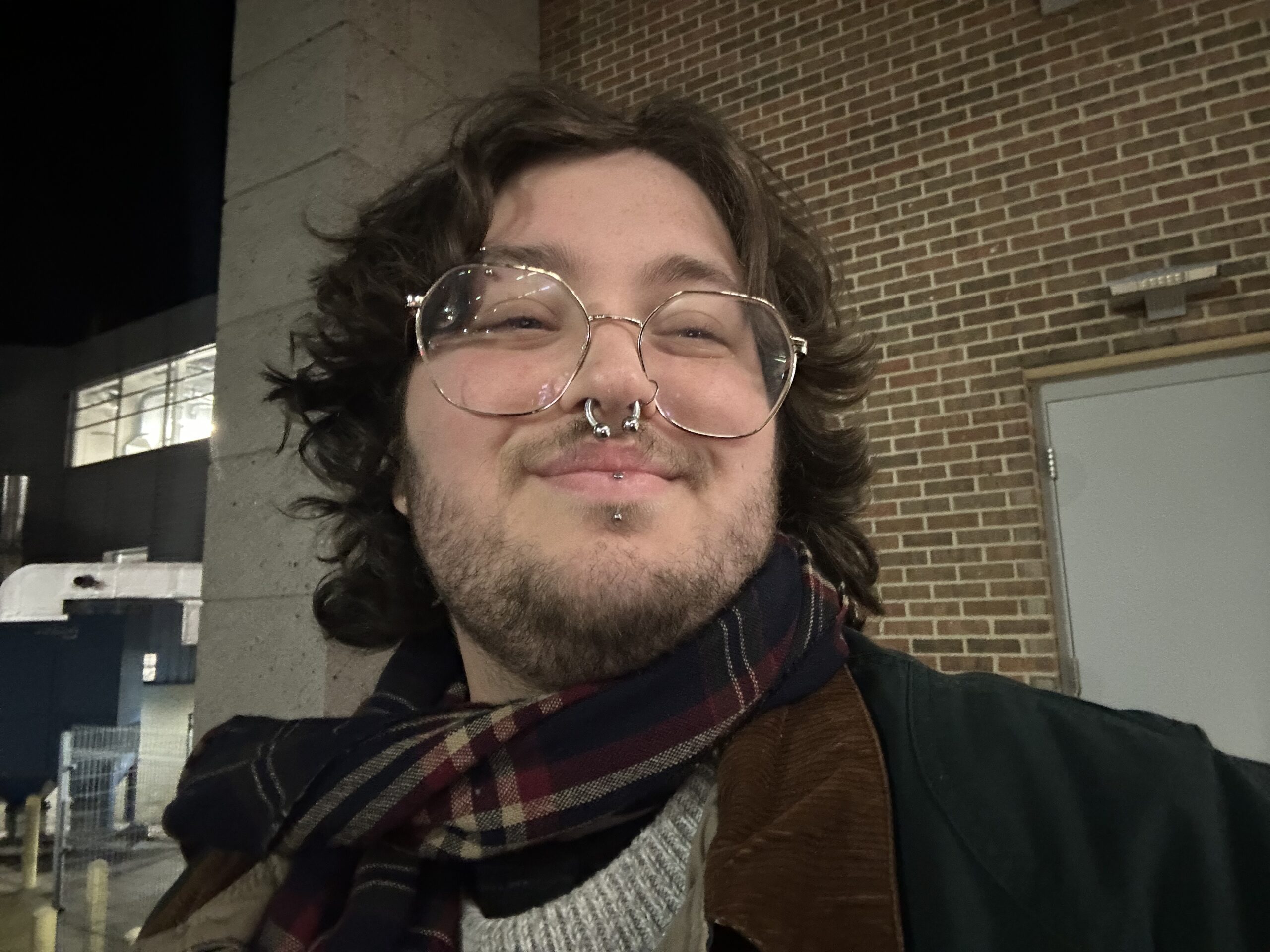
Elliot Cushey is a transmasculine artist and MFA candidate at Kent State University. Their work explores trans identity with a focus on craft, material, and historical precedent, bringing trans experiences into academic spaces and offering documentation of trans lives during a time of erasure. Elliot won Best in Show in the 2nd Annual ActLoCLE Online Juried Art Exhibition for their piece titled “Wood.”
Interviewed by Arron Foster
November 30, 2025
Can you tell us a little more about your artistic background and how you got started?
I received my Bachelor’s of Fine Art at Millersville University. I studied under Brant Schuller and became immediately enthralled with printmaking after my first class. I pretty instantly knew I would want to continue with it as my concentration. I started by exploring works about sex and identity, and used art as a way to find my community. I now live in Northeast Ohio and am still exploring these topics, but have expanded my thoughts on artmaking a lot. I’m still incredibly in love with printmaking and have been exploring how experimental you can get with alternative process.
Where do you find your inspiration?
I began making prints in undergrad that were large scale and technically challenging, as I felt I had to prove myself not only as an artist, but work overtime to prove myself as an artist that was trans. I wanted to be seen as a good artist and good printmaker, and feared others would think my praise was earned from my identity instead of my talent and hard work. This made me work even harder and I wanted to prove to everyone what I already knew. My being trans was not why I got praise, however my need to find community and my want to normalize trans bodies is why I worked harder than anyone else, spent more time in the studio, and made the biggest work in my class. Every day was a new learning opportunity for me and I want to take in as much as I can of every experience. I spend a lot of time reading and studying, most recently about Jenny Holzer,
Tracey Emin, and Glenn Ligon.
Can you walk us through your creative process, from conception to completion?
A large part of my creative process is interaction with others. My interactions with other artists fuel my ideas and my studies in art history impact how I view myself within the cannon of fine art. I am constantly listening to music when making art, most commonly Talking Heads. I’m often taking photos with my friends (who are also artists) in the studio and thinking of new ways to show our experiences to the world through fine art. From there, I will begin image making. As a printmaker, my process is a very communal one. When working large I rely on studio help from others, and it is very common to find me and my peers dancing while printing in the studio and having fun with our practice. Fun and play are big fuelers for me in the studio.
Do you have a favorite medium?
Printmaking has my heart through and through. I’ve managed to mention it in every answer so far which I guess says a lot. I love markmaking, and I think as a trans artist who cares so much about community it is natural for my medium of choice to be one that has a deep history of community and social power.
What motivates you to create?
Connection, community, and the act of archiving. My practice comes from a feverish need to archive my existence and experiences. I do not care that people look at my work and say “Elliot Cushey lived,” but instead “this person lived, was trans, and went through so many experiences I relate to. Trans people exist and that is good.” I think that is why I like mark making and print media so much. No matter the visual representation of my prints, the trans body is always present. It is present in every edition number, every hand registered border. My trans hands are present in almost every aspect of the process. Printmaking demands physicality, and that excites me. My prints would not be physically possible without the existence and evidence of my trans body.
What role do you think artists play in society?
I think artists act as archivists and communicators. Art documents what is old, what is modern, it can predict what is to come. It communicates what we value, what we need to change. Who makes art that is shown is evidence of who we give value to, and what stories we are allowing to be told.
How can your work in particular affect societal issues?
My work, most obviously, affects the societal issue of trans visibility. Most currently my subject matter has shown the trans body within fine art, affecting the visibility of transness. I hope to also affect the societal issue of hope. I have been focusing recently on the power of hope and play, making my work a reminder of the need for both within our society. I see a big division within class as someone from a rural area. There is a lack of education, purposefully, to keep us divided within our own classes. I am conflicted by this when it comes to my own art. I make art about social issues, but realistically if I am participating in a fine art setting my art won’t truly serve the communities they are about. Art in museums exists within the museum walls, hidden behind entrance fees and an unspoken dress code. The people I am trying to reach are not who have access to these things. I have been thinking about social practice and how to make my art receptive to wider audiences as well as accessible to wider audiences.
Does art help you in other areas of your life?
Art really helps my mental health. It gives me purpose and allows me to express my feelings in a way that is given permission to be exaggerated and felt to their fullest extent. My emotions on experiences are meditated on, and drawn out to their fullest potential. It allows me to fully feel my emotions and examine them in a healthy outlet. It also has given me incredible community and friends.
What does community in the arts look like to you?
Community in the art to me looks like sharing opportunity and knowledge. I really enjoy learning about my art friends and their interests. Learning about their life and what drives them to create. Showing up to their shows and sharing their work. If I see any juried opportunities or grants I try to share them with everyone. We need to have each other’s back and make sure opportunities are being shared always instead of being kept to small groups of artists.
What has it meant to you to win Best In Show for the 2nd Annual ActLoCLE Online Juried Art Exhibition?
It really means so much to me. This is my first juried show I have been in that isn’t related to my school or specific to subject matter within my niche (queer art). Winning best in show in an exhibit that is open beyond my professors who already understand my voice and beyond queer artists who already get my vision? It feels so incredibly validating to my voice as an artist and my ability. And I also just love printmaking so much and am so happy I get to show how cool print is to others.
Would you share a little bit about the process behind making “Wood” (the winning piece)?
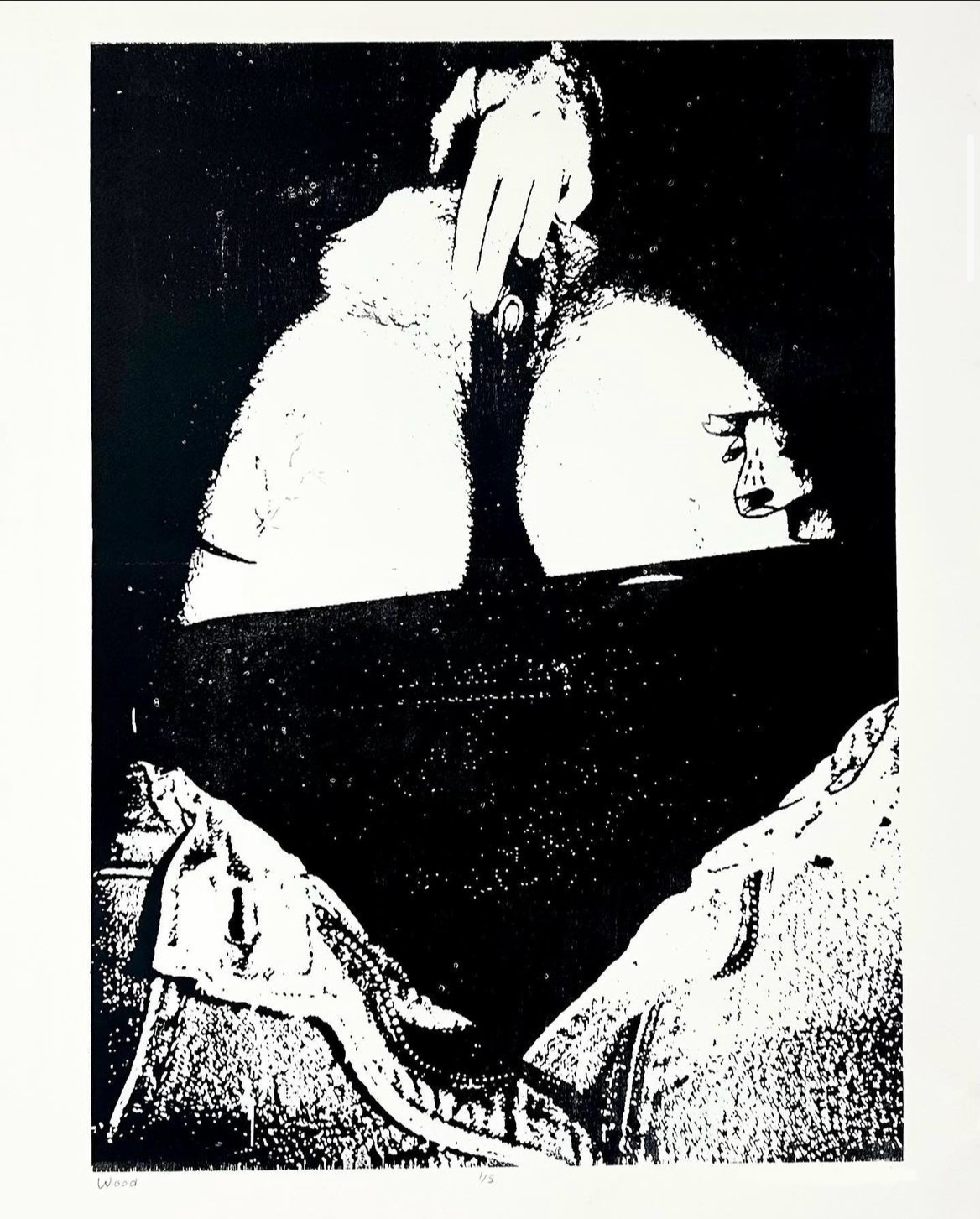
The piece is a large scale woodcut which was incredibly fun to make. My best friend from undergrad shared a studio with me. We are both trans artists and we spent basically every day all day together in undergrad. He was the model for this piece, and the image is from one of the many photoshoots we had in our shared studio. Coming from a little farm town, our only references for trans bodies were ourselves. It makes the piece feel special to me. We were each other’s models because we had no other choice, but it made us incredibly close. I then edited the image in photoshop and used a laser engraver to cut the relief image. I inked it by hand and printed it on Arches cover paper. My choice of paper is very intentional. I always use the highest quality archival paper, to make the point that my subject matter is of value and meant to last in archival form. The title “Wood” both gives recognition to the matrix, but also acts as a play on woods as “wood” is a nickname for penises. The enlargement of the clitoris, which happens as a side effect from testosterone HRT, is oftentimes referred to as a “testosterone dick” within the trans community.
What’s next for you, exhibitions, projects, residencies?
Currently I am working on my Masters of Fine Arts at Kent State University, with a concentration in printmaking. From here I plan to keep building the community around me as well as my portfolio. I have started to explore installation, performance, and relational aesthetics. I enjoy the idea of consciousness raising, and have studied Project Womanhouse a lot. I could see myself trying to engage a queer focused space of similar design. My dream residency is currently the Mattress Factory in Pittsburgh.